
Water Damage Restoration In Orlando, FL
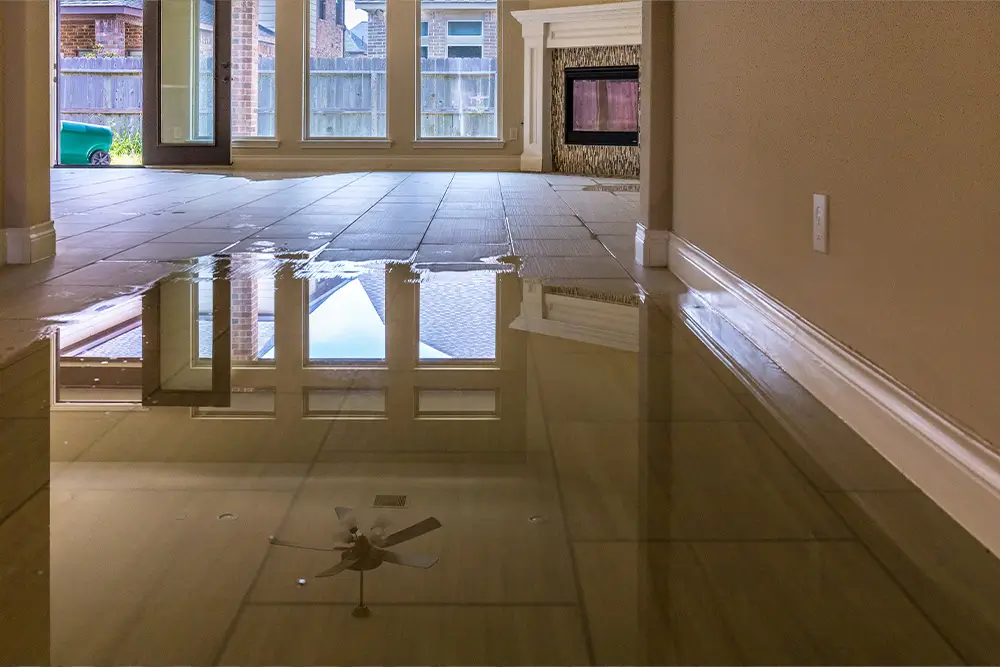
Water does most of its damage in the hours nobody is watching it. A supply line lets go at two in the morning, and by the time you come downstairs the baseboards have wicked it up, the pad under the carpet is holding water like a sponge, and the drywall on the other side of that wall is already dark along the bottom edge. The puddle you can see is the smallest part of the problem.
Global Arch Construction handles emergency water damage restoration in Orlando and the surrounding Central Florida towns. Our office is on Sidney Hayes Rd in south Orlando, so a truck is coming from inside your city rather than driving in from two counties over. Call (407) 989-3960.
Water in the house right now? Call (407) 989-3960. Our emergency line is answered around the clock, including weekends and holidays.
Call (407) 989-3960One thing that separates us from most water mitigation companies in Orlando: we are a licensed and insured residential design-build contractor, not a restoration franchise. We dry your house out and then we put it back together, on one contract. The person who picks up when you call in week three about the cabinet doors is the same person who was standing in your hallway at 3 AM.
What To Do In The First Hour
Before anyone gets there, a few things genuinely change the outcome. Not everything on this list will apply, so take what fits.
Shut The Water Off
Shut the water off at the main if the source is a pipe, a supply line, or a water heater. In most Orlando homes the main valve sits in a green or black box near the sidewalk, or on the exterior wall closest to the street.
Kill The Power
Kill power to the affected rooms at the breaker if water is anywhere near outlets, cords, or a panel. If the panel itself is wet, do not touch it. Wait for us or for the utility.
Photograph Everything
Photograph everything before you move it. Wide shots of each room, then close-ups of the water line on the wall, the source, and any furniture legs sitting in it. Insurers ask for this later and nobody ever has enough.
Get The Small Stuff Off The Floor
Get the small stuff off the floor. Rugs, boxes, electronics, shoes, anything cardboard. Cardboard soaks water up fast and then transfers it into whatever is stacked on top.
Protect Your Carpet
Put foil or plastic under furniture legs so wood finish and metal casters stop staining the carpet. Those stains do not come out.
Leave The Air Conditioning Running
Leave the air conditioning running if the electrical is safe. It pulls humidity, and in Central Florida that matters more than it does almost anywhere else.
Do Not Run A Shop Vac On Dirty Water
Do not run a shop vac on anything that came from a toilet, a drain, or outside the house. That water carries bacteria and you will spread it.
What you should skip: renting fans from the hardware store and pointing them at wet drywall. It moves air across the surface while the cavity behind it stays saturated. You end up with a dry-looking wall and a mold problem eight weeks later.
How The Work Actually Runs
Water Extraction And Source Control
The first crew stops the water and gets the standing volume out. We use truck-mounted and portable extraction units, and on carpet we use weighted extraction heads that pull water out of the pad rather than just the face fibers. Water extraction in Orlando homes is usually complicated by slab-on-grade construction, because water spreads sideways under baseboards and into adjoining rooms instead of draining anywhere.
We also map the moisture before we plan anything. Thermal imaging finds cold wet patches behind finished surfaces, and a penetrating meter confirms the reading. This tells us how far the water traveled, which is nearly always further than the visible damage suggests.
Drying The Structure
Then air movers and commercial dehumidifiers go in, sized to the volume of the affected space and the class of loss. Drying is arithmetic. We take moisture readings daily against a dry standard from an unaffected part of the same house, and the equipment stays until the numbers land, not until a set number of days is up.
Most jobs run three to five days on equipment. Hardwood, plaster, and anything that soaked into a slab take longer. We will tell you which one you have on day one instead of letting it become a surprise.
Cleaning, Disinfecting, And Demolition
Some materials dry and stay. Some do not. Carpet pad, wet insulation, particleboard cabinet boxes, and drywall that sat saturated long enough all get removed rather than dried, because they will not come back structurally even if the meter reads dry. We cut drywall above the water line in a straight line so the patch and the finish work later look like a wall instead of a repair.
Where the water was dirty, we clean and apply an antimicrobial to the exposed framing and subfloor before anything closes back up.
Rebuilding
This is the part most water damage restoration services in Orlando hand off to somebody else. We do it ourselves. Drywall, texture, paint, baseboard, trim, flooring, tile, cabinets, and the permits that go with any of it. Our crews already build kitchens and baths across Orange County, so the reconstruction is normal work for us instead of a subcontracted afterthought.
The Kinds Of Water Losses We Get Called For
Burst Pipes And Failed Supply Lines
Burst pipe water damage repair in Orlando homes has a pattern to it. Braided washing machine hoses and toilet supply connectors fail more than anything else, usually at the crimp, usually while nobody is home. Polybutylene, the gray plastic pipe run in a lot of Central Florida houses built between roughly 1978 and 1995, fails at the fittings and tends to keep failing once it starts. If we open a wall and find gray poly, we will tell you, because repairing that one spot is treating a symptom.
Roof Leaks
Roof leak water damage restoration is its own animal, because the leak is rarely above the stain. Water tracks along a truss chord, follows a nail, and drops through the ceiling several feet from where it got in. We find the actual entry point, dry the attic insulation and the ceiling assembly, and coordinate the roof repair so it does not do it again in September. Related: storm damage repairs.
Sewage Backups And Contaminated Water
Sewage cleanup is mostly containment and removal work. Category 3 water, which is what the industry calls anything coming from a sewer line, a toilet trap, or standing floodwater, carries bacteria into everything porous it touches. Drywall, carpet, pad, and insulation come out. Hard surfaces get cleaned and disinfected. We set containment and negative air so the contamination stays in the room it started in.
Older Orlando neighborhoods have a specific version of this. Cast iron sewer laterals installed mid-century are now well past their service life, and when the bottom of the pipe scales through, waste backs up into the lowest fixture in the house. If your home is in College Park, Audubon Park, or the older parts of Winter Park and this has happened more than once, the pipe is the problem, not the plunger.
Flooded Home Cleanup
Flooded home cleanup after a hurricane or a stalled summer storm brings water that has been outside, which means it is contaminated regardless of how clean it looks. It also usually means a lot of it. We prioritize getting the volume out and the structure open to dry, because in August heat the clock on mold is measured in days.
Appliance And Water Heater Failures
Water heaters fail from the bottom of the tank, quietly, often into a garage or a hall closet. Refrigerator ice maker lines fail behind the fridge where nobody looks. Dishwashers leak under the cabinet run and into the toe kick. These are slow losses, so by the time you notice, the subfloor and the cabinet boxes have been wet for a while.
Not Sure Which One You Have?
Call (407) 989-3960. Our emergency line is answered around the clock, including weekends and holidays.
Mold Remediation After Water Damage
In Central Florida, mold after a water loss is a question of when rather than whether. Ambient humidity here runs high enough that wet organic material starts colonizing in roughly 24 to 48 hours. That is the entire reason we push to get equipment in the same day.
If mold is already growing when we arrive, remediation is a separate scope from drying and it runs differently. Containment goes up. Negative air machines with HEPA filtration run inside the containment. Affected porous materials get bagged and removed, framing gets HEPA vacuumed and treated, and the air gets scrubbed before anything closes up.
Florida regulates mold remediation and requires state licensing to perform it. Anyone who offers to spray your attic with bleach and call it done is not doing remediation, and bleach does not solve a mold problem on porous material anyway. For losses above the threshold where an independent clearance test makes sense, we will tell you to hire your own assessor rather than take our word for it. The company that does the remediation should not be the company that grades it.
Why Call A Builder Instead Of A Restoration Franchise
Most water damage jobs in Orlando are actually two jobs stapled together. There is mitigation, which is the wet part, and there is reconstruction, which is the part where your house looks like a house again. The industry usually splits these between two companies.
That split is where homeowners lose months. The mitigation company finishes, pulls the equipment, invoices the carrier, and moves on. Now you are holding a house with the drywall cut out to four feet and you are the one calling contractors, getting bids, and explaining a scope you did not write.
We do both halves. The person who documented the loss is the person who writes the rebuild scope, which means the reconstruction estimate lines up with what the carrier already agreed to pay for. Our permits go through Orange County’s Fast Track portal or your city’s system, and residential plan review here usually runs 10 to 15 business days. You hear from us during that wait.
Our estimates come to you as written line items. Materials separated from labor, allowances broken out. When something changes later, that is a conversation about one line rather than an argument about the whole number.
What Central Florida Does To A Wet House
Contractors who learned this trade somewhere else get Florida wrong in predictable ways.
The Slab
Almost every house here sits on a concrete slab, and concrete holds water. A slab that took on water releases it back into the room for weeks afterward, which is why flooring installed too soon over a “dry” slab cups, telegraphs, or delaminates six months later. We test slab moisture before flooring goes down, not after.
The Humidity
Humidity is the other one. Outdoor dew points here sit high enough through the summer that opening windows to dry a house makes it wetter. Dehumidification has to be mechanical and it has to be sized correctly. An oversized air conditioner is a related trap, because it satisfies the thermostat before it runs long enough to pull moisture out, and you end up with a house that is cold and clammy at the same time.
The Calendar
Then there is the calendar. Afternoon convective storms from June through September, and named storms on top of that. Every restoration company in the region gets slammed in the same week, which is exactly when response time separates the companies who staff for it from the ones who do not.
Insurance, And The Deadlines That Catch People Out
Most Florida homeowners policies cover sudden and accidental discharge of water. A supply line that bursts, a water heater that lets go, a pipe that fails. What they generally do not cover is gradual seepage that went on for weeks, and they do not cover flood at all. Rising water from outside the structure needs a separate flood policy, usually through the NFIP.
Two Florida deadlines are worth knowing before you need them. Under current state law you generally have one year from the date of loss to file a new property insurance claim, and 18 months for a supplemental or reopened claim. Those windows are much shorter than they used to be, and people who wait to see whether the stain gets worse find out the hard way. Florida also no longer allows new assignment of benefits agreements on property insurance, so the days of signing your claim over to a contractor are gone. Your claim stays yours.
What We Do On The Insurance Side
What we do on the insurance side: document the loss properly from the first hour, write scopes in the format carriers and adjusters actually work from, and meet the adjuster on site so the walkthrough happens with someone there who knows what got cut out and why. We do not negotiate your claim for you and we are not your public adjuster. Read your own policy, or hire someone licensed to read it with you.
What A Job Like This Costs
The honest answer is that the range is enormous, and anyone who quotes you a number over the phone before seeing it is guessing. A single wet closet from a leaking supply line and a two-story loss with sewage in it are not remotely the same job. The spread between them can easily be twenty to one.
What actually moves the number: how many rooms took water and whether it crossed into a second floor, how long it sat before drying started, whether the water was clean or contaminated, how much of what got wet was porous, whether cabinets and flooring have to be replaced rather than dried, whether mold is already growing, and how much reconstruction the rebuild takes.
When it is an insured loss, most homeowners pay their deductible and the carrier covers the balance of the covered scope. We come out, look at it, and hand you a written line-item estimate at no charge. If the project does not make sense at what it will actually cost, we will say so.
Where We Work
Our office is in south Orlando and most of our work sits inside an hour of it.
Orlando
All of it, from the older bungalows in College Park and Delaney Park to the newer subdivisions out east. Cast iron drain lines and 1950s wiring in the north, slab leaks and builder-grade plumbing in the newer stock.
Winter Park
Water damage restoration in Winter Park usually means an older, higher-value home where the finishes matter. Plaster, hardwood, and original millwork all dry differently than modern construction and are worth saving rather than replacing, so we plan for that up front.
Lake Nona
Water damage restoration in Lake Nona is mostly newer construction, which brings its own failure modes. PEX manifold connections, tankless units, and second-floor laundry rooms sitting directly above finished living space. When a second-floor line fails here, the water is in the ceiling of the room below within minutes.
Dr. Phillips
Water damage cleanup in Dr. Phillips often involves larger homes with pool equipment, outdoor kitchens, and multiple zones of mechanical equipment. More square footage under air means more places for a slow leak to run unnoticed.
Windermere
Emergency water extraction in Windermere frequently means lakefront property and large footprints. We bring equipment sized for the volume rather than making three trips.
Altamonte Springs
Water damage repair in Altamonte Springs covers a lot of 1970s and 1980s housing stock, which is prime polybutylene and aging water heater territory. Condos and townhomes here also mean shared walls, so a leak in one unit is often two units’ problem.
Kissimmee
Water damage restoration in Kissimmee includes a heavy share of short-term rental and vacation property, where a leak can run for days between guests. We work with remote owners and property managers and document everything so you are not guessing from another state.
Also Serving
Winter Garden, Clermont, St. Cloud, Bay Lake, Lake Buena Vista, Maitland, Apopka, Oviedo, Ocoee, Sanford, and Ocala. We take selected projects along the I-4 corridor into Tampa. If you are not sure whether your address is too far out, call and ask rather than assuming.
Questions We Get Asked
How Fast Can You Get Here?
For emergencies inside Orange and Seminole counties we are usually on site within about an hour of your call. Outside that ring it depends on traffic and time of day. During a named storm, every restoration company in Central Florida is triaging, and we will give you a real window instead of a comfortable one.
Do You Actually Answer The Phone At Night?
Yes. Our office hours are Monday through Friday, 9 AM to 5 PM, but the emergency line at (407) 989-3960 is answered outside those hours, on weekends, and on holidays. Water damage does not keep business hours.
How Long Does Drying Take?
Usually three to five days with equipment running. Hardwood floors, plaster, and water that went into a slab take longer. We measure daily and pull equipment when the readings say the structure is dry, not when the calendar says so.
Can You Save My Hardwood Floors?
Sometimes. It depends on how long the water sat, what the subfloor is, and whether the boards have started to cup or crown. Engineered wood is usually a loss once the core swells. Solid hardwood caught early can often be dried in place with specialty mats. We can tell you which after we take readings, and we would rather try than default to tear-out.
Will There Be Mold?
If wet material sits for more than a day or two in this climate, very likely. That is the argument for calling immediately rather than waiting to see whether it dries on its own. If mold is already there, remediation gets scoped separately and it is done under containment.
Do You Work With My Insurance Company?
We document the loss thoroughly, write scopes in the format adjusters work from, and meet your adjuster on site. Your claim and your policy stay in your hands. Florida no longer permits new assignment of benefits agreements on property insurance, and we would not ask for one anyway.
Do You Handle The Rebuild Or Just The Drying?
Both, under one contract. Drywall, texture, paint, trim, flooring, tile, cabinets, permits, inspections. That is the main reason people call a design-build contractor for this instead of a mitigation-only outfit.
What If The Leak Is Still Happening?
Shut the main off if you can find it and call us. If you cannot find it or cannot turn it, call anyway and we will talk you through it while a crew is already moving.
Get A Truck Moving
Call (407) 989-3960 for emergency water damage restoration in Orlando, or request a free estimate if the water is already stopped and you are figuring out the repair. Either way you get a written line-item estimate at no cost, and you get the same company for the drying and the rebuild.
Global Arch Construction
9640 Sidney Hayes Rd Ste 777Orlando, FL 32824
- Phone:
- (407) 989-3960
- Office hours:
- Monday to Friday, 9 AM to 5 PM
- Emergency water damage line:
- answered 24 hours a day, 7 days a week